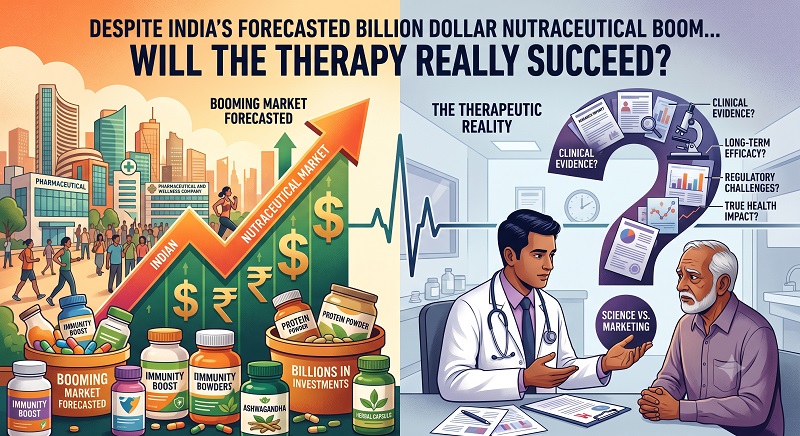
The recent projection that India’s nutraceutical market is expected to nearly double to US$57 billion by 2030 is undoubtedly exciting. Rising health awareness, increasing lifestyle diseases, preventive healthcare, digital commerce and supportive government initiatives are all contributing to unprecedented growth in this sector.
But I believe we are asking the wrong question.
The real question is not:
“How big will the nutraceutical market become?”
The question should be:
“Will this growth actually improve health outcomes?”
Because if patients continue to become sicker despite consuming more supplements, then we have created a larger market—not a healthier nation.
The Missing Link
Over the past decade, nutraceuticals have become mainstream.
Consumers today have access to thousands of products promising immunity, gut health, weight loss, better joints, improved skin, heart health, cognition, longevity and energy.\
Yet obesity continues to rise.
Diabetes continues to rise.
Fatty liver disease continues to rise.
Digestive disorders continue to rise.
Sarcopenia is increasingly common.
Nutritional deficiencies remain widespread.
Clearly, simply increasing consumption of supplements does not automatically translate into better health.
We Need to Stop Selling Products and Start Delivering Therapy
One of the biggest misconceptions in our industry is that nutraceuticals are simply another consumer product.
They are not.
When developed correctly, prescribed appropriately and supported by evidence, nutraceuticals can become an integral component of disease management.
But therapy demands much higher standards than marketing.
Therapy requires:
- Scientific rationale
- Correct ingredient selection
- Clinically meaningful dosages
- High bioavailability
- Appropriate combinations
- Patient-specific recommendations
- Integration with diet, lifestyle and medical treatment
Without these, even the best ingredients may fail to deliver meaningful outcomes.
More Ingredients Do Not Mean Better Science
Today’s marketplace is flooded with products carrying impressive labels:
- “40 ingredients”
- “50 superfoods”
- “100 herbs”
- “Complete nutrition”
Unfortunately, biology doesn’t work that way.
The human body responds to effective doses—not impressive labels.
Adding dozens of ingredients at nutritional dust levels may create attractive marketing, but rarely creates therapeutic efficacy.
Instead, formulations should answer one simple question:
Why is every ingredient present, and what clinical purpose does it serve?
The Era of Evidence-Based Nutrition
Healthcare professionals are becoming increasingly discerning.
They are asking:
- Where is the clinical evidence?
- What dose has been studied?
- Is the formulation bioavailable?
- Can this ingredient survive digestion?
- Will it actually reach the target tissue?
These are the questions that will define the next generation of nutraceutical companies.
Marketing may drive the first purchase.
Clinical outcomes drive the second.
Personalisation Will Replace Generalisation
No single supplement can work for everyone.
The nutritional needs of a bariatric patient differ dramatically from those of an elderly individual with sarcopenia.
A patient with chronic kidney disease cannot consume nutrition the same way as an athlete.
Someone with IBS requires a completely different nutritional strategy from someone recovering after surgery.
Future success lies in precision nutrition—not one-size-fits-all supplementation.
The Responsibility of the Industry
As manufacturers, scientists, healthcare professionals and nutrition experts, we have an ethical responsibility.
We must resist the temptation to chase trends.
Instead, we should build products that solve real clinical problems.
Products that physicians can confidently recommend.
Products supported by science rather than exaggerated claims.
Products designed for outcomes—not merely sales.
Success Should Be Measured Differently
Perhaps by 2030 India will indeed become a US$57 billion nutraceutical market.
But I hope we celebrate something even bigger.
Fewer hospitalisations.
Better surgical recovery.
Reduced muscle loss in ageing.
Improved metabolic health.
Better gut health.
Healthier pregnancies.
Stronger children.
Improved quality of life.
Because ultimately, the success of our industry should never be measured by market valuation alone.
It should be measured by the number of lives we genuinely improve.
The future belongs not to companies that sell the most supplements.
It belongs to those that deliver the most meaningful health outcomes.
That is the true promise of nutraceuticals.
And that is the future worth building.